
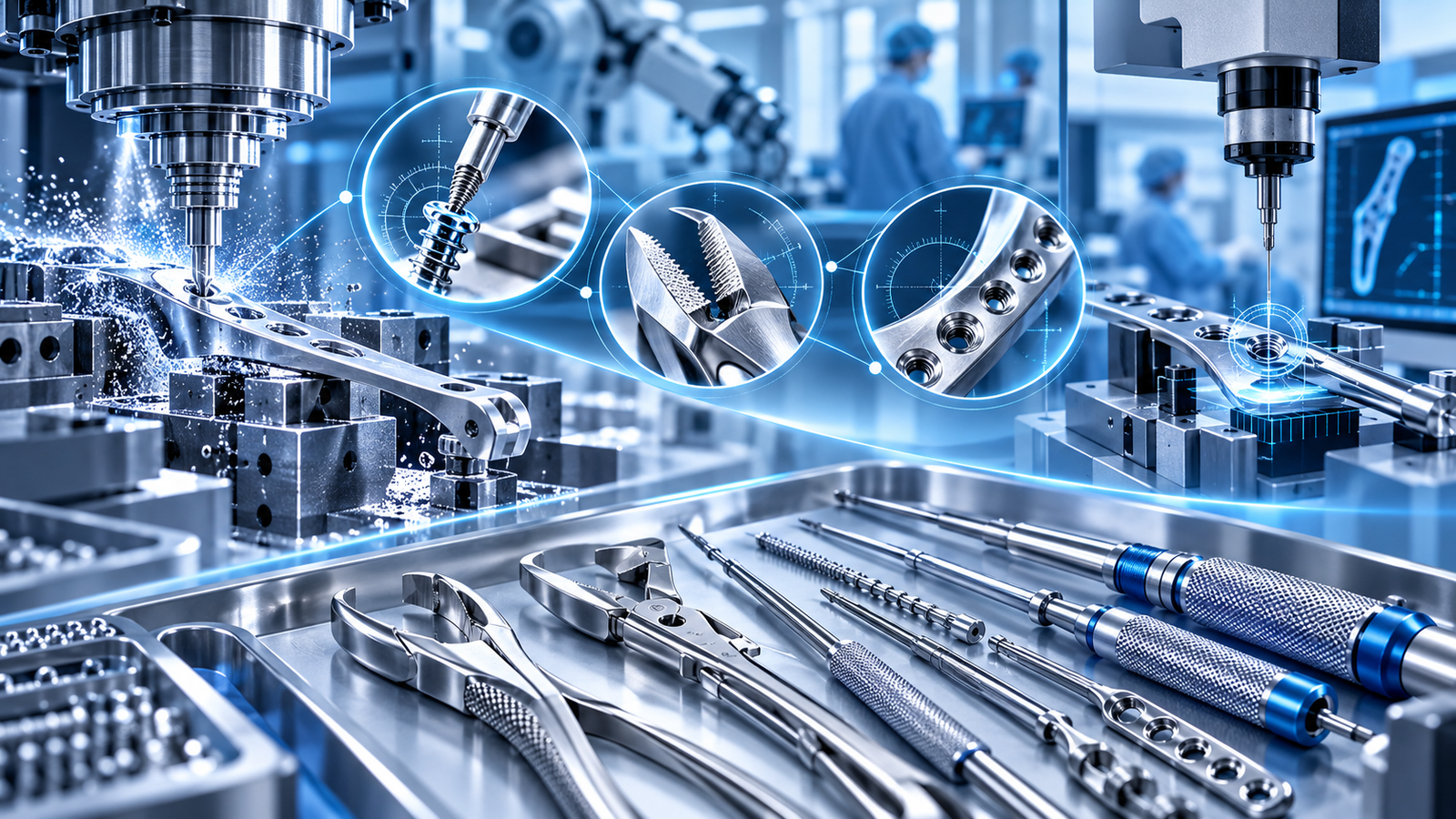
Orthopedic instruments play a critical role in modern surgical procedures. From bone-cutting and fixation tools to surgical retractors, drills, guides, and specialized instruments, these products must deliver consistent performance when precision matters most. The quality of an orthopedic instrument depends not only on its design but also on how accurately it is manufactured.
Precision manufacturing combines advanced machinery, engineering expertise, controlled production processes, and rigorous quality inspection to produce orthopedic instruments that meet demanding requirements. For manufacturers serving healthcare markets worldwide, precision is essential for building reliable products and maintaining confidence among medical professionals.
What Is Precision Manufacturing?
Precision manufacturing is a production approach focused on achieving highly accurate dimensions, tolerances, surface finishes, and repeatability. In orthopedic manufacturing, even small dimensional variations can affect how an instrument functions during a surgical procedure.
Modern manufacturing technologies such as CNC machining, computer-aided design (CAD), advanced measurement equipment, and automated production systems allow manufacturers to produce complex components with a high degree of consistency.
By controlling each stage of production, manufacturers can reduce variations and ensure that instruments perform according to their intended specifications.
Importance of Accurate Instrument Design
The manufacturing process begins with an accurate and well-engineered design. CAD software allows engineers to create detailed digital models of orthopedic instruments before production begins.
Engineers can evaluate dimensions, angles, connection points, and functional characteristics during the design stage. This helps identify potential manufacturing issues before physical production starts.
Accurate digital designs also provide a consistent reference for CNC machines and inspection equipment. As a result, manufacturers can maintain greater consistency when producing multiple units of the same instrument.
CNC Machining for Consistent Results
Computer Numerical Control (CNC) machining is an important technology in the production of precision orthopedic instruments. CNC machines can manufacture complex components according to programmed digital specifications.
Compared with manual production methods, CNC machining provides greater repeatability and control over dimensions. This is especially important when instruments include small holes, precise edges, threaded sections, specialized tips, or complex geometries.
CNC machining can also help manufacturers maintain consistent quality across production batches, making it suitable for both standard instruments and customized manufacturing requirements.
Material Selection and Surface Quality
The quality of an orthopedic instrument also depends heavily on material selection. Materials such as stainless steel and other specialized alloys are commonly considered for orthopedic applications because of their strength, durability, corrosion resistance, and suitability for demanding environments.
However, selecting an appropriate material is only one part of the process. Manufacturing and finishing techniques must also be carefully controlled to achieve the required surface characteristics.
Proper surface finishing can improve an instrument’s appearance, durability, cleanability, and resistance to corrosion. Depending on the product and applicable requirements, manufacturers may use processes such as polishing, grinding, passivation, or other controlled finishing techniques.
Strict Quality Control and Inspection
Precision manufacturing must be supported by comprehensive quality control. Inspection procedures help manufacturers verify that finished instruments conform to their specified dimensions and requirements.
Modern measurement technologies such as coordinate measuring machines (CMM), digital measuring instruments, optical inspection systems, and other precision equipment can be used to verify critical features.
Quality control may take place throughout the manufacturing process rather than only at the final stage. In-process inspections can identify deviations early, reducing waste and helping maintain consistency.
Documentation and traceability are also important elements of an effective quality system. Maintaining production and inspection records can help manufacturers monitor processes and support consistent product quality.
Skilled Engineering and Manufacturing Teams
Advanced machinery alone cannot guarantee precision. Experienced engineers, machinists, technicians, and quality-control professionals are essential to maintaining reliable manufacturing processes.
Skilled teams understand how different materials respond to machining, how tooling affects dimensional accuracy, and how production parameters can influence surface quality. Their knowledge allows manufacturers to identify potential problems and continuously improve manufacturing processes.
Combining skilled professionals with modern equipment creates a stronger manufacturing environment capable of meeting demanding production requirements.
Benefits for Healthcare Professionals
High-quality orthopedic instruments can provide important practical benefits during surgical procedures. Instruments manufactured to accurate specifications can support predictable handling, proper alignment, and consistent functionality.
For medical professionals, reliability is an important consideration when selecting surgical instruments. Consistent manufacturing can also help healthcare facilities maintain standardized instrument sets and reduce problems associated with dimensional variation or poor finishing.
Ultimately, precision manufacturing contributes to the development of dependable tools that support healthcare professionals in performing their work effectively.
The Future of Orthopedic Instrument Manufacturing
The future of orthopedic instrument manufacturing will continue to be influenced by automation, digital design, advanced machining, improved inspection technologies, and data-driven quality management.
Technologies such as additive manufacturing, artificial intelligence-assisted inspection, digital production monitoring, and advanced materials may create new opportunities for developing increasingly complex and customized orthopedic instruments.
At the same time, the fundamentals of precision, quality control, material expertise, and manufacturing discipline will remain essential.
Precision at Strength International
At Strength International, we recognize that manufacturing orthopedic instruments requires a strong commitment to precision and quality. Based in Sialkot, Pakistan, our manufacturing capabilities combine technical expertise, modern production methods, and controlled quality processes to support the needs of customers in global healthcare markets.
From initial design and material selection to machining, finishing, inspection, and final preparation, every stage contributes to the quality of the finished product. Our focus is on delivering orthopedic instruments that reflect precision engineering, manufacturing consistency, and dependable performance.
As the orthopedic industry continues to evolve, precision manufacturing will remain a fundamental part of innovation. By combining advanced technology with skilled expertise and rigorous quality practices, manufacturers can help develop orthopedic instruments that support modern surgical needs and contribute to better healthcare outcomes worldwide.


Add comment