
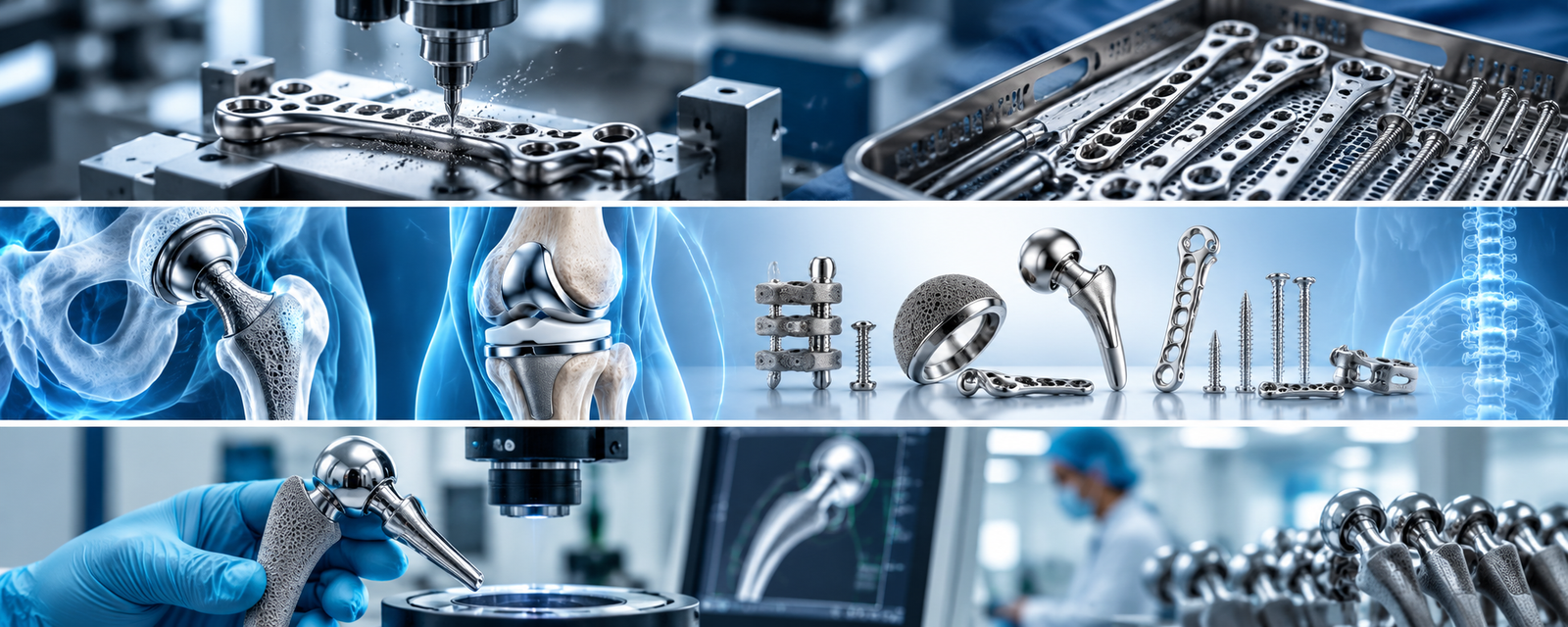
Orthopedic implants are highly specialized medical devices used to support, stabilize, repair, or replace parts of the human musculoskeletal system. Because these products are used in surgical procedures, their quality, consistency, and reliability are extremely important. A small manufacturing variation can potentially affect the performance or compatibility of an implant, making strict quality standards an essential part of orthopedic manufacturing.
For manufacturers, maintaining high-quality standards is not simply about producing a finished product. It involves controlling the entire manufacturing process, from material selection and product design to machining, finishing, inspection, documentation, and final preparation.
What Are Quality Standards in Orthopedic Manufacturing?
Quality standards provide a structured framework for controlling how medical products are designed, manufactured, inspected, and documented. They help manufacturers establish consistent processes and identify potential risks throughout production.
In orthopedic implant manufacturing, quality management can involve controls for raw materials, production equipment, manufacturing parameters, inspection procedures, traceability, documentation, and product release.
Following applicable quality and regulatory requirements helps manufacturers create repeatable processes and maintain consistent product quality across different production batches.
Why Material Quality Matters
The materials used in orthopedic implants must be carefully selected according to their intended application. Common materials include titanium and titanium alloys, stainless steel, and cobalt-chromium alloys.
Material properties such as strength, corrosion resistance, durability, and compatibility with the intended application can influence the design and performance of an implant.
Quality control begins before production by verifying that incoming materials meet the required specifications. Proper material identification and traceability can also help manufacturers maintain control throughout the manufacturing process.
Precision and Manufacturing Consistency
Orthopedic implants often contain complex geometries and critical dimensions. Manufacturing processes therefore need to achieve a high level of accuracy and repeatability.
Modern technologies such as CNC machining, computer-aided design, precision grinding, and advanced measurement systems can help manufacturers maintain dimensional consistency.
Quality standards encourage manufacturers to establish controlled production processes rather than relying solely on final inspection. Monitoring critical manufacturing parameters throughout production can help identify variations early and reduce the possibility of inconsistent products.
Inspection and Testing
Inspection is a fundamental part of orthopedic implant quality management. Manufacturers may use a combination of dimensional inspection, visual examination, surface inspection, and other applicable testing methods to verify that products meet their defined specifications.
Advanced measurement equipment can help assess critical dimensions and tolerances with a high degree of accuracy. Depending on the product and applicable requirements, additional testing may also be required to evaluate specific material or mechanical characteristics.
Effective inspection systems help identify nonconforming products before they move to the next stage of production or reach the customer.
Traceability and Documentation
Quality is not only about the physical characteristics of an orthopedic implant. Documentation and traceability are also important components of a reliable manufacturing system.
Manufacturers may maintain records relating to raw materials, production processes, inspections, equipment, and product batches. Proper documentation creates a history of how products were manufactured and inspected.
Traceability can also support investigations and corrective actions when a manufacturing issue is identified. This provides greater control over the production process and helps manufacturers continuously improve their systems.
Importance of Skilled Professionals
Advanced manufacturing equipment is valuable, but experienced professionals remain essential to maintaining quality. Engineers, machinists, technicians, quality-control specialists, and production teams all contribute to the manufacturing process.
Skilled professionals understand machining requirements, material behavior, measurement techniques, production challenges, and quality-control procedures. Their expertise helps manufacturers identify potential issues and maintain consistent production standards.
Continuous training and process improvement can further strengthen a company’s quality management system.
Building Trust in Global Healthcare Markets
Orthopedic manufacturers often serve customers across multiple countries and healthcare markets. Meeting applicable quality and regulatory requirements can help manufacturers establish credibility and build long-term relationships with international customers.
Healthcare organizations and distributors need confidence that the products they source are manufactured under controlled and consistent processes. A strong quality management approach demonstrates that a manufacturer takes product reliability and manufacturing responsibility seriously.
For international suppliers, maintaining appropriate documentation and consistent quality processes can also support smoother communication and supply-chain operations.
Continuous Improvement in Orthopedic Manufacturing
Quality standards should not be viewed as a one-time requirement. Effective manufacturers continuously evaluate their processes and look for opportunities to improve efficiency, accuracy, consistency, and reliability.
Process monitoring, inspection data, customer feedback, internal audits, equipment maintenance, and corrective actions can all contribute to continuous improvement.
As manufacturing technologies develop, companies can also adopt new tools and processes that improve production capabilities while maintaining appropriate quality controls.
Strength International: Commitment to Quality
At Strength International, we recognize that quality is fundamental to orthopedic implant manufacturing. Based in Sialkot, Pakistan, we focus on precision manufacturing, controlled production processes, technical expertise, and rigorous quality practices.
Our approach covers key stages of manufacturing, including material handling, precision production, finishing, inspection, and product preparation. By combining modern manufacturing capabilities with experienced professionals and quality-focused processes, we aim to provide dependable orthopedic solutions for customers in global healthcare markets.
Quality standards provide the foundation for consistency and trust in the orthopedic industry. As technology continues to advance, manufacturers that maintain strong quality systems will be better positioned to deliver reliable products and meet the evolving needs of healthcare professionals worldwide.
Ultimately, quality in orthopedic implant manufacturing is about more than meeting specifications. It is about building confidence through precision, consistency, traceability, and a continuous commitment to improvement.


Add comment